
H-Beams Vs. I-Beams: Which Is Best for Your Construction Project?

Steel beam selection affects more than structural calculations. The profile you choose influences fabrication time, installation complexity, structural performance, and overall project cost.
At a glance, H-beams and I-beams can look nearly identical. Once they’re carrying loads across a facility expansion, seismic retrofit, industrial structure, or custom build, those differences become much more noticeable.
Beam shape determines how weight is distributed, how far a beam can span, how efficiently steel is used, and where each option performs best.
This guide compares H-beams and I-beams side by side, covering the key differences, advantages, limitations, and common applications so you can make decisions earlier, avoid costly redesigns later, and specify steel that fits the demands of the project.
Table of Contents
The Use of Steel Beams in Construction
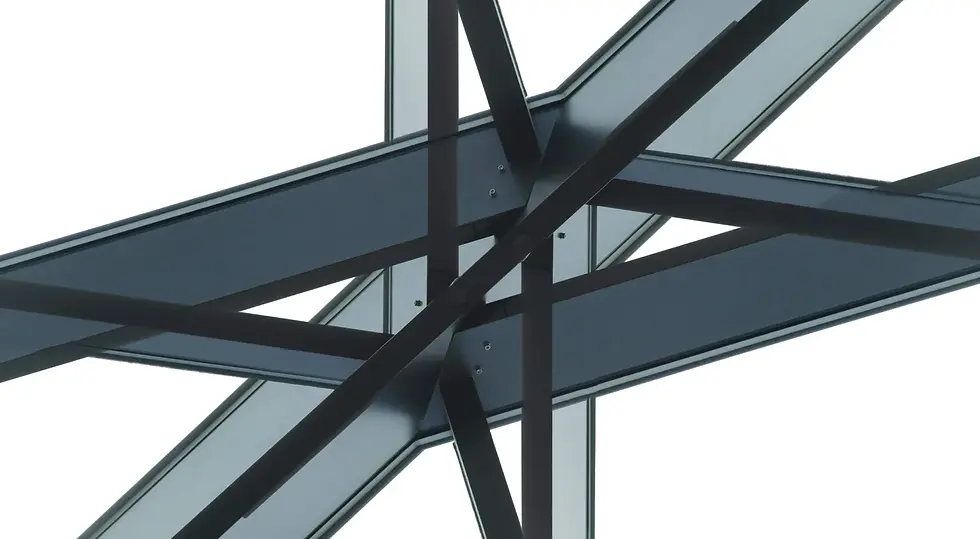
Steel beams show up almost everywhere once you start looking for them: industrial facilities, schools, commercial buildings, seismic retrofits, stair systems, structural supports, and custom architectural work.
Steel remains a preferred structural material because it solves several problems at once.
Compared with wood, steel offers greater strength for its size and does not warp, split, or attract pests.
Compared with concrete, steel allows for longer spans with less bulk and can often accelerate installation timelines because many components arrive fabricated and ready for placement.
Additional advantages include:
High strength-to-weight ratio
Dimensional consistency
Better long-span capability
Easier modification and reinforcement
Compatibility with custom fabrication
Beam selection depends on structural goals, load requirements, and fabrication needs.
Common structural beam types include:
H-Beams: Wide flanges and a thicker web designed to carry heavy loads across long spans.
I-Beams: Narrower flanges and efficient vertical load support with reduced material weight.
T-Beams: Frequently used in composite floor systems and reinforcement applications.
C-Channels (C-Beams): Often selected for framing, supports, and secondary structural elements.
Box Beams: Hollow sections valued for torsional resistance and clean architectural appearance.
At Madden Fabrication, projects often start with a sketch, photo, or concept and evolve into fabricated structural components built to project specifications, whether for industrial facilities, structural upgrades, or custom construction.
H-Beams Vs. I-Beams: 5 Key Differences
H-beams and I-beams share the same basic concept: use material efficiently by placing more steel farther from the center, where it contributes most to strength.
Small differences in geometry create noticeable differences in performance.

#1: Design
The fastest way to tell these beams apart is by looking at the flange.
An I-beam has narrower flanges and typically tapers from edge to web. Its proportions reduce weight while maintaining vertical strength.
An H-beam has wider, flatter flanges and a thicker center web. The cross-section appears more balanced and substantial.
Manufacturing methods differ as well.
I-beams are commonly produced through rolling processes that shape steel into standardized profiles.
H-beams may be hot-rolled or fabricated by welding plates together to achieve custom dimensions and capacities.
That flexibility makes H-beams common in projects where standard stock sizes won’t cut it.
#2: Weight-Bearing Capability
Beam shape changes how forces travel through steel.
H-beams generally carry greater loads because their wider flanges spread force more evenly across the section. Their geometry performs well under both vertical and lateral loading conditions.
I-beams excel in applications dominated by vertical loads. Their shape concentrates material efficiently while helping resist localized deformation under compression.
For long spans, heavy structural support, or higher load demands, H-beams are often the stronger candidate.
#3: Resistance to Torsion and Bending
Structures rarely experience a perfectly straight downward force.
Wind, shifting loads, vibration, seismic movement, and equipment activity introduce twisting and multi-directional stress.
H-beams resist these conditions more effectively because of their:
Wider flange width
Increased cross-sectional area
Thicker web construction
That added rigidity improves resistance to both bending and torsional movement.
I-beams still perform well under expected loading conditions but are generally less effective where rotational forces become a larger design consideration.
#4: Ease of Handling
Strength creates tradeoffs.
I-beams are lighter and often easier to transport, stage, lift, and install.
That can reduce:
Equipment requirements
Labor effort
Installation time
Structural dead load
H-beams require more coordination due to added weight but may reduce the total number of structural members needed in some designs.
Installation efficiency depends on the complete system, not individual beam weight alone.
#5: Cost
Material volume heavily influences cost.
I-beams generally cost less because they use less steel and weigh less overall.
H-beams typically carry higher material and fabrication costs, especially when custom dimensions or welded construction are required.
Cost comparisons should account for more than the price per beam.
A heavier beam that eliminates additional supports or reduces field modifications can lower total project costs.
If you need help selecting the right beam, our team at Madden Fabrication can review concepts, specifications, sketches, and reference photos before fabrication begins.

What Are the Pros and Cons of H-Beams?
H-beams offer high load capacity, excellent structural stability, and strong resistance to bending and twisting. Their tradeoff is increased weight and material costs.
Pros
Excellent load-bearing capability
Performs well across long spans
Handles vertical and lateral forces effectively
Strong resistance to bending and torsion
Can be fabricated in custom dimensions
Cons
Higher material cost
Increased transportation and lifting requirements
More steel can increase the overall project weight
May exceed requirements for lighter applications
H-beams are commonly selected when structural performance matters more than minimizing material use.
What Are the Pros and Cons of I-Beams?
I-beams prioritize efficiency.
Their geometry removes unnecessary weight while preserving strong vertical support characteristics.
Pros
Lower material cost
Easier transportation and installation
Efficient strength-to-weight ratio
Strong performance under vertical loads
Common standardized sizes
Cons
Lower overall load capacity than H-beams
Reduced resistance to torsional forces
Less effective for heavy multi-directional loading
Limited flexibility compared with fabricated beam assemblies
I-beams often fit projects where reducing structural weight and installation complexity creates measurable value.
I-Beam Vs. H-Beam Application
Determining which beam fits the project starts with the conditions the structure will experience once construction ends.
Structures Utilizing I-Beams
Commercial buildings: I-beams support flooring and roofing systems while limiting unnecessary structural weight.
Residential structural additions: I-beams support openings, framing systems, stairways, and remodeling projects.
Mezzanines and platforms: I-beams provide efficient vertical load support without requiring oversized structural members.
Bridges with controlled loading conditions: I-beams provide reliable support when span and weight requirements align with standard beam profiles.
Equipment supports: I-beams perform well in applications with predictable loading conditions.
Structures Utilizing H-Beams
Industrial facilities: H-beams support heavy equipment loads and withstand demanding operating environments.
Structural building frames: H-beams accommodate larger spans and provide greater load-bearing capacity.
Seismic upgrades and reinforcement projects: H-beams provide additional stiffness that can improve structural performance.
Manufacturing plants and processing facilities: H-beams provide long-term durability and resistance to substantial loads.
Custom-fabricated structural systems: H-beams accommodate projects in which standard beam sizes do not meet structural requirements.
Madden Fabrication: Your Source for Expertly Crafted Steel Beams
Based in Portland and serving clients across the U.S., Madden Fabrication supports industrial, commercial, and structural projects ranging from facility maintenance and seismic improvements to custom fabrication and large-scale industrial work.
With more than 20 years supporting industrial businesses in the Pacific Northwest, our team brings fabrication expertise shaped by project conditions across construction, processing, manufacturing, and energy environments. We’ve even performed work to support facilities such as geothermal plants.
Whether you already have engineered drawings or only an early concept, Madden Fabrication can help refine specifications and fabricate structural components built for the application.
Explore all fabrication capabilities, review beam fabrication services, or request a quote to start the conversation.


Comments